In pharmaceutical research and drug development, selecting the correct reference product is essential for generating reliable study results and meeting regulatory requirements. Whether a company is developing a generic medicine, conducting a bioequivalence (BE) study, or evaluating a new treatment in a clinical trial, the product used for comparison influences study design, data interpretation, and regulatory acceptance.
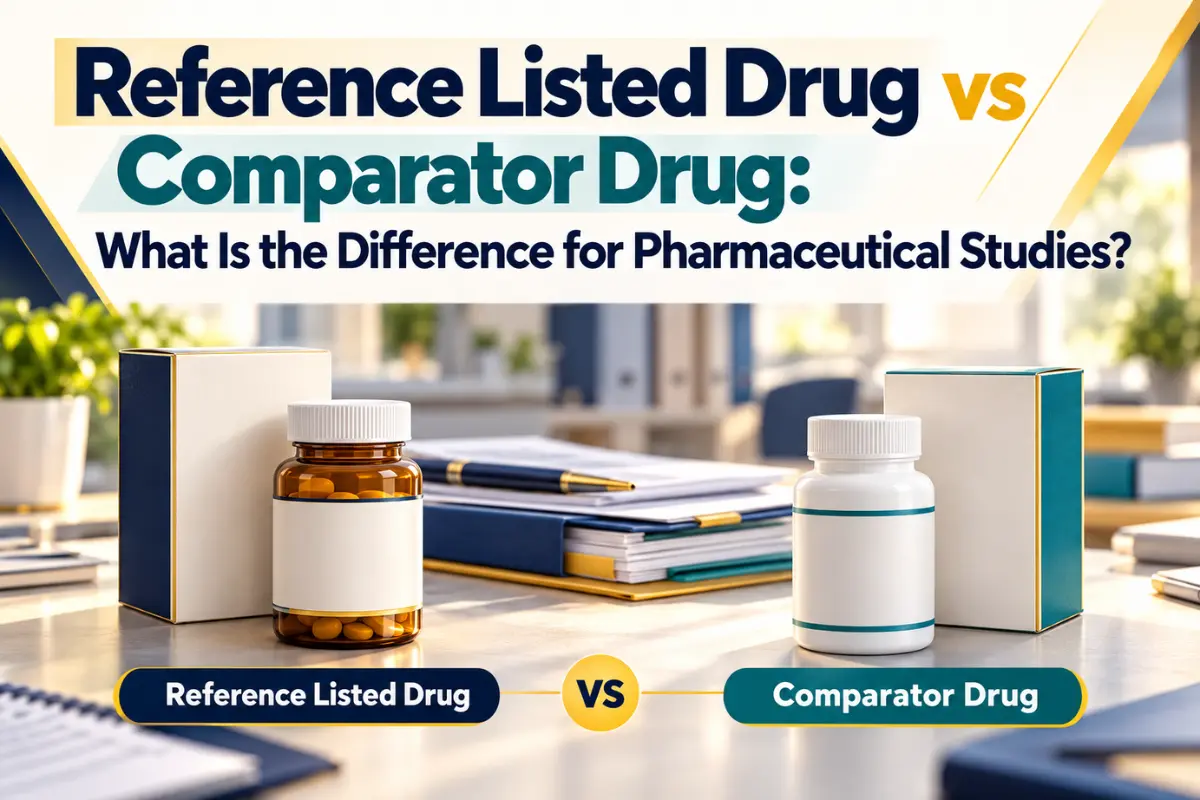
Two terms frequently encountered in this context are Reference Listed Drug (RLD) and comparator drug. Although both may refer to products used as benchmarks in pharmaceutical studies, they have different meanings. An RLD is a specific regulatory designation under the United States Food and Drug Administration (FDA) framework, whereas a comparator drug is a broader term describing a product or control used to evaluate another treatment.
Understanding this distinction helps pharmaceutical manufacturers, generic drug developers, and clinical research organisations select appropriate products, plan studies, and meet the requirements of their target markets.
What is a Comparator Drug?
A comparator drug is a medicine or control used as a benchmark against which an investigational or test product is evaluated.
Depending on the study, it may help researchers assess safety, efficacy, pharmacokinetics, or pharmaceutical quality. In bioequivalence studies, an approved reference medicine may be used to compare the rate and extent of absorption of a proposed generic product. In clinical trials, an established treatment may serve as an active comparator to determine whether a new medicine provides similar or improved outcomes. Comparators may also be used in pharmaceutical quality assessments, including comparisons of dissolution profiles.
Common types of comparators include:
- Active comparator: An established medicine used to evaluate the performance of an investigational treatment or generic product.
- Placebo comparator: An inactive preparation designed to resemble the investigational treatment, used when appropriate to assess treatment effects in clinical trials.
- Historical comparator: Previously collected clinical data or established outcomes used as a benchmark for evaluating new study results.
The appropriate comparator depends on the study objective, protocol, and applicable regulatory requirements. The term describes the product’s role in a study rather than a specific regulatory status.
What is a Reference Listed Drug (RLD)?
A Reference Listed Drug (RLD) is a specific regulatory designation used by the US FDA for an approved drug product that serves as the reference for a generic drug application submitted through the Abbreviated New Drug Application (ANDA) pathway.
The RLD provides the regulatory basis against which a proposed generic product is evaluated. Under applicable FDA requirements, a generic drug generally must have the same active ingredient, strength, dosage form, and route of administration as the RLD. It must also satisfy relevant quality requirements and demonstrate bioequivalence where required. Its labelling must generally align with that of the RLD, subject to permitted differences.
The FDA identifies RLDs in its Approved Drug Products with Therapeutic Equivalence Evaluations, commonly known as the Orange Book. This designation is important because a product containing the same active ingredient as another medicine is not automatically an acceptable reference for every regulatory submission.
RLD is primarily a US regulatory term. Other countries may use different terminology and procedures for selecting reference products. Therefore, a medicine accepted as a comparator in one market does not automatically qualify as the RLD for an FDA-regulated generic application.
How Reference Product requirements differ across markets
Reference-product selection becomes more complex when pharmaceutical development involves multiple countries. Regulatory authorities may differ in their requirements for product origin, approval status, documentation, and comparator acceptability.
- United States: For an ANDA submission, applicants must identify the appropriate RLD and meet FDA requirements for pharmaceutical equivalence and bioequivalence, as applicable. The Orange Book is an important resource for identifying designated reference products. Applicants must also verify which product the FDA requires for in vivo bioequivalence testing.
- European Union: The European Union follows its own framework for selecting reference medicinal products and comparators. Generic applications must meet the applicable European regulatory requirements, while clinical trials may use an authorised medicine or another appropriate control. Additional requirements for investigational medicinal products may apply depending on the product’s status and intended use.
- International studies: The World Health Organization (WHO) provides guidance on comparator selection for multisource pharmaceutical products, including situations where an innovator product is unavailable in the local market. International guidance, including the ICH M13A guideline on bioequivalence for immediate-release solid oral dosage forms, also addresses reference-product selection within its scope.
A product accepted in one jurisdiction may not automatically be acceptable in another. Companies conducting multinational studies should therefore confirm the requirements of each target regulatory authority before procuring study products.
RLD vs Reference Standard (RS): An Important Distinction
Another term that can cause confusion in US generic drug development is Reference Standard (RS).
The RLD and RS are related but serve different purposes.
- The RLD is the designated drug product on which an ANDA applicant relies as the basis for its generic application.
- The Reference Standard (RS) is the specific drug product designated by the FDA for use in required in vivo bioequivalence studies.
In many cases, the RLD and RS are the same product. However, the FDA may designate a different product as the Reference Standard, including in certain circumstances where the original RLD is discontinued or unavailable for testing. This distinction matters because using the correct product for a bioequivalence study does not remove the applicant’s other obligations concerning the RLD. Pharmaceutical teams should verify both designations using the FDA Orange Book and relevant product-specific guidance before finalising their study plans.
Why comparator selection matters in bioequivalence studies
Bioequivalence studies assess whether two pharmaceutical products exhibit comparable bioavailability under specified study conditions. For many immediate-release systemic products, the assessment involves pharmacokinetic parameters such as maximum observed plasma concentration (Cmax) and the area under the plasma concentration-time curve (AUC).
The selected reference product must satisfy the requirements applicable to the intended regulatory submission. Using a product that is not acceptable under those requirements may mean that the study data cannot adequately support the application, potentially resulting in additional testing or regulatory delays.
Before initiating a study, researchers should confirm the product’s identity, strength, dosage form, route of administration, market of origin, and regulatory acceptability. A comparator used in one country should not automatically be assumed suitable for another jurisdiction.
Sourcing and documentation requirements
Correct product selection must be accompanied by appropriate sourcing, storage, and documentation procedures. Pharmaceutical companies need to establish that the comparator is authentic, traceable, and suitable for the intended study.
- Product identity and batch documentation: Verify the product name, active ingredient, strength, manufacturer, batch number, expiry date, and packaging details. A Certificate of Analysis (CoA), where applicable, may support batch-quality assessment, but it does not by itself establish that the product is the correct regulatory reference.
- Chain of custody and traceability: Maintain purchase orders, supplier invoices, shipping documents, and batch records to establish the product’s source and movement through the supply chain. Traceability is particularly important when the comparator is procured from an overseas market.
- Storage and expiry: Products must be stored and transported according to the manufacturer’s specified conditions. Temperature-sensitive medicines may require a validated cold chain, while other products may need protection from light or moisture. The remaining shelf life should be sufficient for the planned study and associated requirements.
- Importation and regulatory compliance: Before importing a comparator, verify the permissions, customs documentation, and regulatory requirements applicable to its intended use. In India, relevant requirements should be assessed under applicable Central Drugs Standard Control Organisation (CDSCO) regulations and other relevant rules. Importing a product for research or clinical investigation should not be treated as equivalent to importing it for routine commercial distribution.
Common mistakes to avoid
A frequent mistake is assuming that any approved medicine containing the same active ingredient can serve as the reference product. Regulatory acceptability may depend on the specific product designation, strength, dosage form, market of origin, and intended study. Confusing the RLD with the Reference Standard can also lead to sourcing errors. Although these products are often the same, their regulatory roles differ. In addition, inadequate batch documentation or uncertainty about storage conditions can compromise a product’s suitability even when the correct medicine has been selected. These risks can be reduced by confirming regulatory requirements before procurement, documenting the rationale for comparator selection, and verifying each batch before it is accepted for study use.
Conclusion
Although an RLD can function as a comparator, the terms are not interchangeable. Their differences become clearer when their regulatory status, selection criteria, and purpose are considered separately.
Reference Listed Drug (RLD) refers to a specific drug product designated under the US FDA framework as the reference for a generic drug application.
- It has a formal role in the FDA’s Abbreviated New Drug Application (ANDA) pathway.
- Selection: Identified through applicable FDA listings and regulatory requirements, including the Orange Book.
- Product requirements: The proposed generic must meet applicable requirements for active ingredient, strength, dosage form, route of administration, quality, and bioequivalence.
- Primary purpose: Provides the regulatory basis for evaluating a proposed generic drug and is primarily associated with US generic drug development and approval.
Comparator drug refers to a medicine or control used to evaluate a test product or investigational treatment in a study.
- It may or may not have a specific regulatory designation, depending on the study and jurisdiction.
- Selection: Determined by the study objectives, protocol, and applicable regulatory requirements.
- Product types: May include an approved medicine, an active control, a placebo, or another appropriate control.
- Primary purpose: Supports comparisons of safety, efficacy, pharmacokinetics, or pharmaceutical quality and is used across clinical trials, bioequivalence studies, and other comparative pharmaceutical research.
The distinction is particularly important in bioequivalence studies, where the correct reference product is essential for generating data that support a regulatory submission. Pharmaceutical teams must also distinguish the Reference Listed Drug (RLD) from the FDA-designated Reference Standard and account for differences in reference-product requirements across international markets.
By confirming regulatory acceptability, maintaining batch-level traceability, and ensuring appropriate sourcing and storage, pharmaceutical developers can reduce avoidable delays and protect the integrity of their studies.