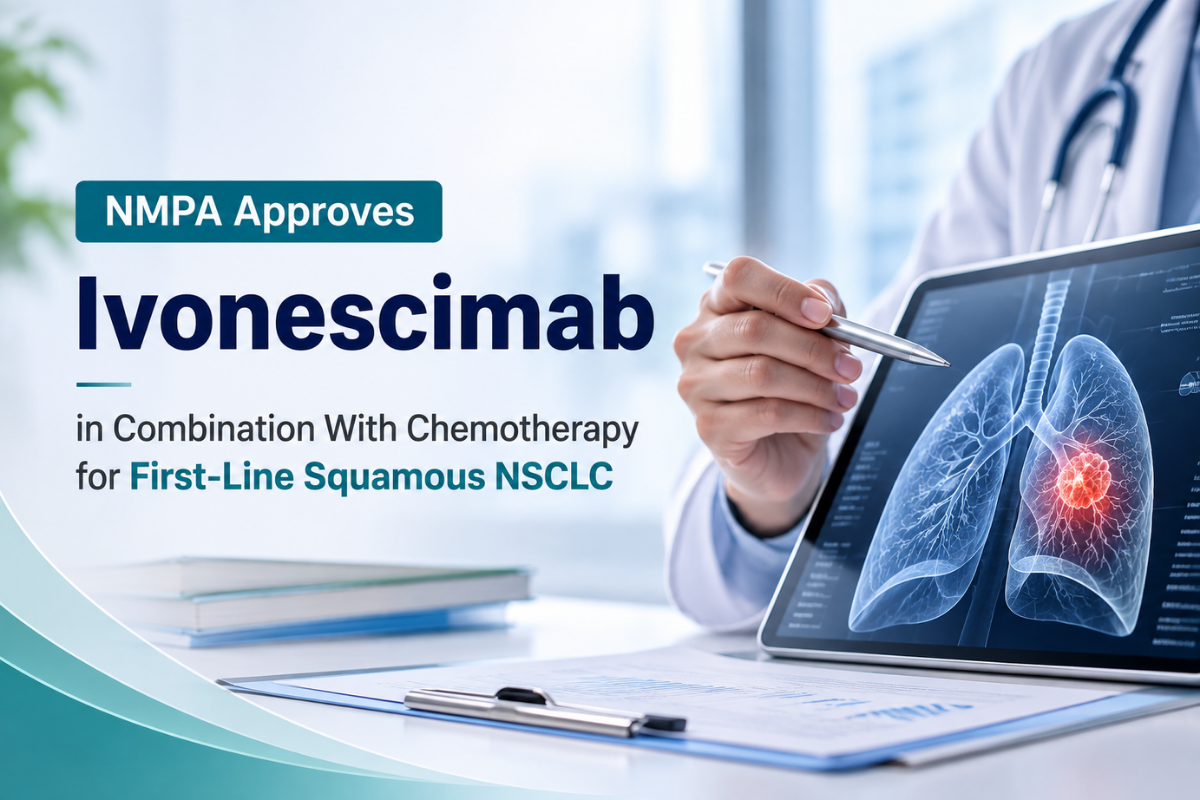
With the advent of new immuno-oncology techniques, the therapy landscape for advanced squamous non-small cell lung cancer (sq-NSCLC) is changing. Regardless of PD-L1 expression, Ivonescimab in combination with chemotherapy was approved by China’s National Medical Products Administration (NMPA) on August 12, 2026, as a first-line treatment for patients with advanced squamous non-small cell lung cancer.
The major Phase III HARMONi-6 study results, which showed statistically significant increases in progression-free survival (PFS) and overall survival (OS) when compared to tislelizumab plus chemotherapy, served as the basis for the approval.
An Overview of Squamous NSCLC
Non-small cell lung cancer accounts for the majority of lung cancer cases and includes several histological subtypes, with squamous cell carcinoma representing one of the major forms.
Advanced sq-NSCLC can be particularly challenging to manage because of its clinical characteristics and the relatively limited availability of targeted therapies compared with non-squamous NSCLC. For patients without actionable driver alterations, first-line treatment has traditionally centered on platinum-based chemotherapy combined with an immune checkpoint inhibitor.
The development of approaches capable of simultaneously addressing immune suppression and tumor angiogenesis therefore represents an area of considerable interest.
Ivonescimab: A Novel Bispecific Antibody
Ivonescimab, is a bispecific antibody designed to simultaneously target programmed cell death protein 1 (PD-1) and vascular endothelial growth factor (VEGF).
By combining these two activities within a single molecule, Ivonescimab is designed to provide both immune checkpoint blockade and anti-angiogenic activity.
VEGF can contribute to an immunosuppressive tumor microenvironment in addition to its role in the development of tumor blood vessels. Therefore, concurrent blocking of VEGF and PD-1 may improve anticancer immune activity while altering the tumor microenvironment.
Why Combine Ivonescimab With Chemotherapy?
Chemotherapy and immunotherapy can provide complementary antitumor effects. Chemotherapy directly damages and kills rapidly dividing tumor cells, while immune checkpoint inhibition can restore T-cell activity against cancer cells.
The addition of VEGF blockade provides another potential mechanism. VEGF-mediated signaling can contribute to abnormal tumor vasculature and immune suppression. Inhibiting this pathway may help create a tumor microenvironment that is more favorable for immune-cell activity.
Ivonescimab therefore combines PD-1 inhibition and VEGF targeting in one bispecific antibody, while chemotherapy provides an additional cytotoxic mechanism. This biological rationale formed the basis for evaluating Ivonescimab plus platinum-based chemotherapy in first-line advanced sq-NSCLC.
HARMONi-6: Key Clinical Evidence
The NMPA approval was based on HARMONi-6, a randomized, double-blind, Phase III trial involving 532 patients with previously untreated, unresectable stage IIIB, IIIC, or stage IV sq-NSCLC.
Patients received either:
- Ivonescimab + platinum-based chemotherapy, or
- Tislelizumab + platinum-based chemotherapy
The study demonstrated a significant PFS benefit with Ivonescimab. Median PFS was 11.1 months versus 6.9 months, corresponding to a 40% reduction in the risk of disease progression or death (HR, 0.60; 95% CI, 0.46–0.78; P<0.0001).
The regimen also improved tumor response, with an objective response rate (ORR) of 75.9% versus 66.5% and a median duration of response of 11.2 versus 8.4 months.
Importantly, the interim OS analysis showed a median OS of 27.9 months with Ivonescimab versus 23.7 months with tislelizumab, representing a 34% reduction in the risk of death (HR, 0.66; 95% CI, 0.50–0.87; P=0.0017).
Why Is This Approval Important?
The HARMONi-6 results are notable because the study did not simply compare an experimental regimen with chemotherapy alone. Instead, Ivonescimab plus chemotherapy was compared directly with an established PD-1 inhibitor plus chemotherapy regimen. The trial therefore provides evidence that simultaneously targeting PD-1 and VEGF may offer additional clinical benefit over PD-1 inhibition plus chemotherapy alone.
Importantly, the benefit was demonstrated in both major efficacy endpoints PFS and OS and was observed across prespecified patient subgroups, including patients with different PD-L1 expression levels.
The findings may also be relevant to the longstanding question of whether anti-angiogenic approaches can be safely incorporated into treatment strategies for squamous NSCLC. Unlike the historical experience with bevacizumab, Ivonescimab represents a different molecular approach in which VEGF targeting is combined with PD-1 blockade within a bispecific antibody.